
There are very few rules in art, but light and shadow is one of them. There is always light and there is always shadow. That’s the rule. Without it, your coloring will be flat. Light always shines at an angle, even when it shines from directly overhead. Overhead lighting casts rays at both angles. Only artificial light shines from beneath an object and it also shines at both angles.
Center Highlight

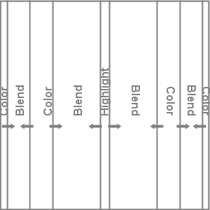
Can point horizontally, vertically or diagonally
1) Apply a dark color to both sides and a midtone between them, leaving space for the center.
2) Blend the colors toward the center with a blender pencil.
3) Apply white in the center and blend again.
4) Apply solvent and blend with a brush. (optional)
2) Blend the colors toward the center with a blender pencil.
3) Apply white in the center and blend again.
4) Apply solvent and blend with a brush. (optional)
Center Light


1) Apply a dark color to the corners and a midtone 1/3 of the way inward.
2) Blend the colors together with a blender pencil.
3) Push the blended color toward the center with a blender pencil.
4) Apply white in the center and blend outward.
5) Apply solvent and blend with a brush. (optional)
2) Blend the colors together with a blender pencil.
3) Push the blended color toward the center with a blender pencil.
4) Apply white in the center and blend outward.
5) Apply solvent and blend with a brush. (optional)
High Noon or Midnight


1) Apply a dark color to the bottom corners and a midtone 1/3 of the way inward.
2) Blend the colors together with a blender pencil.
3) Push the blended color toward the center with a blender pencil.
4) Apply white in the top center and blend outward.
5) Apply solvent and blend with a brush. (optional)
2) Blend the colors together with a blender pencil.
3) Push the blended color toward the center with a blender pencil.
4) Apply white in the top center and blend outward.
5) Apply solvent and blend with a brush. (optional)
Directional Light


1) Apply a dark color to the corners and a midtone 1/3 of the way inward.
2) Blend the colors together with a blender pencil.
3) Push the blended color toward the center with a blender pencil.
4) Apply white in the center and blend outward.
5) Apply solvent and blend with a brush. (optional)
2) Blend the colors together with a blender pencil.
3) Push the blended color toward the center with a blender pencil.
4) Apply white in the center and blend outward.
5) Apply solvent and blend with a brush. (optional)


